Device file
The Orgone Accumulator
The accumulator was the object that turned orgone from theory into a regulatory case. Reich presented it as a concentrator of orgone energy; the FDA treated it as a therapeutic device when health claims were attached.
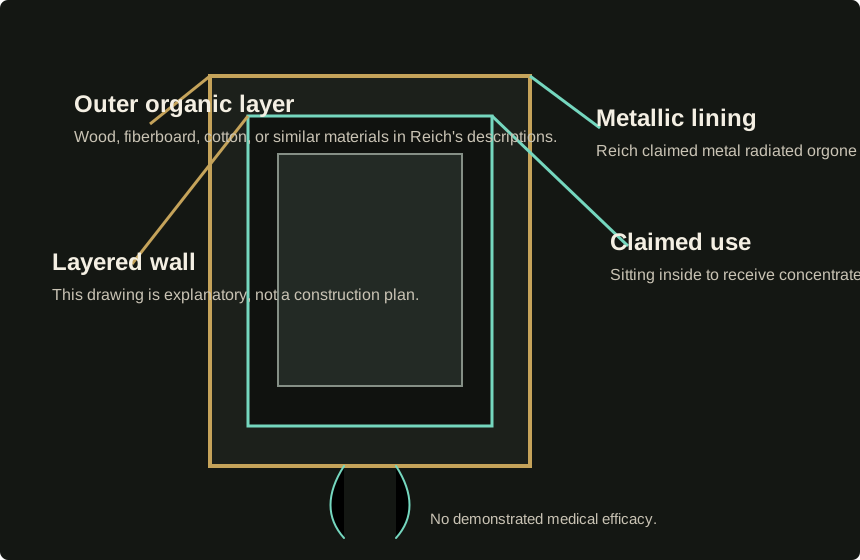
What the accumulator was
The orgone accumulator was usually described as a box or cabinet with layered walls: organic materials on the outside and metallic material toward the interior. Reich claimed this arrangement gathered orgone from the environment and concentrated it inside the enclosure. The person, animal, or sample placed inside was then supposed to receive a stronger orgone exposure than in ordinary air.
The FDA’s own historical page uses a photograph caption to identify “assorted versions of orgone accumulators” as devices developed by Reich to collect an ethereal substance he believed was vital to health and longevity. That phrasing is useful because it describes the device without endorsing the premise.
What Reich and proponents claimed
Reich’s accumulator claims were medical, biological, and observational. He believed the device could affect vitality, cancer biopathy, burns, blood, and general health. Those claims were not casual advertising copy at the margins of the work; they were integrated into his later theory of orgone as a biological energy.
The key distinction is between subjective experience and efficacy. A box can feel warm; quiet sitting can change attention, breathing, or expectation; a historical user can report benefit. None of that proves the existence of orgone or establishes that a device treats disease.
Reich’s experiments and observational claims
Reich connected accumulator work to laboratory and clinical observations, including earlier bion experiments and later cancer-related claims. The Reich Museum publication chronology shows how accumulator theory, ORANUR, and other orgone publications clustered in the late 1940s and early 1950s.
A neutral reading does not need to decide that every historical observation was invented. It only needs to ask whether the observations had adequate controls, blinded assessment where appropriate, objective endpoints, and independent replication. By those standards, the accumulator did not become a validated medical intervention.
Independent replication attempts
Accumulator defenders have pointed to small physiological studies and demonstrations; skeptics have pointed to thermal gradients, placebo effects, poor controls, and the absence of robust independent confirmation. The scientific problem is not that “energy” can never affect biology. Heat, light, sound, ionizing radiation, and electromagnetic fields are real. The problem is that orgone was not isolated as a distinct measurable entity.
The cleanest steelman is this: if the accumulator works as claimed, it should produce a repeatable physical signal or clinical endpoint distinguishable from ordinary temperature, ventilation, expectation, and rest. That signal should survive a dummy-box control and independent replication. The accepted literature does not show that result.
For a stricter non-therapeutic protocol, read the orgone accumulator experiment guide or use the replication checklist tool.
Why it became a legal object
The accumulator entered federal court because it was distributed with therapeutic claims and related writings. In the FDA oral history interview, William Goodrich described the government’s case as one against a product supported by writings that explained its claimed life-force effect. The injunction theory treated those writings as labeling tied to a device.
The First Circuit decision in Wilhelm Reich v. United States did not validate orgone science; it affirmed contempt judgments after the court concluded the injunction had been disobeyed. That is why the accumulator belongs on both the science page and the FDA case page.
Sources used on this page
- FDA history: device regulation after 1938 - FDA caption identifies Reich accumulators as devices developed to collect an ethereal substance.
- FDA oral history interview with William Goodrich - FDA counsel recollection of the Reich case, labeling theory, and destruction issue.
- Wilhelm Reich v. United States, 239 F.2d 134 - First Circuit contempt appeal describing the injunction, trial, and jurisdiction issues.
- Wilhelm Reich Museum: Reich's research and publications - Museum chronology for bions, orgonomy, ORANUR, cloudbuster, and Arizona expedition.
- Skeptic's Dictionary: orgone energy - Skeptical overview of orgone claims and reception.